Really. An empty nest.

Throughout the month of July, we had a front-row seat to the entire process. The stage: a spruce tree just outside our bedroom window. The accommodation: a perfectly crafted nest of twigs, mud, and whatever else the robin could appropriately gather.
First came a single, unmistakable blue egg. Then, a day later, another. And finally, one more perfectly formed oval—the last maternal installment. Three eggs.
Like scenes from a scripted play, we watched as the robin came and went, faithfully tending to the cluster of eggs that were hers to steward. Then, roughly two weeks later, three tiny chicks replaced the bright blue eggs.

At that point, the work changed—and so did the workforce. In a perfectly choreographed tag-team effort, mother and father robin took turns feeding their young. Over and over throughout the daylight hours, they arrived with beaks full of worms for the persistently open, heavenward-tilted mouths of the nestlings.
By nightfall, the father disappeared, and the mother settled in, covering the growing mound of young life. This routine continued for about two more weeks. And with each passing day, the chicks grew—at an extraordinary rate—because very soon, they would receive their eviction notice. And a vacant nest would be all we could see.
And so it was.
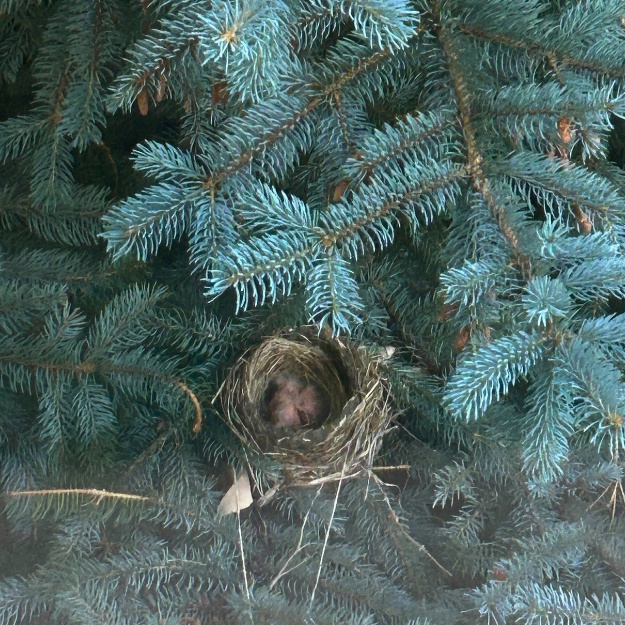
One day, a quick glance out our window revealed the change. The once-bustling hub of activity had gone silent. Empty.
For the next few days, we could hear what we couldn’t see—a “conversation” in robin style. Birds chirping back and forth, most likely during flying and hunting lessons.
Curious, we did some research and learned that for at least two more weeks, the parents remained nearby—tracking, protecting, and providing for the trio, even though the nest was empty.

One day, another glance out the window prompted a question in my mind:
Is the nest ever really empty?
Does a hollowed-out clump of grass and mud mean the job is done?
When chicks take flight, is the work complete?
Does self-sufficiency signal true independence?
Eggs give way to wings, and wings propel a purpose—but purpose doesn’t amputate us from our past.

An empty nest… or an empty bedroom… or an empty seat around the kitchen table doesn’t mean the work is finished, or that we’ve punched the clock. It simply means the work has been relocated. There will be fewer worms, and more shared flights. Less protection, and more conversation. Less control, and more life-shaping dialogue.
Even with an empty nest, the job is not done. Never.
This is for our good.
This is by design.
God’s design.
Our Father. Provider. Protector. Present—from the beginning.
With us to the end.



{ 0 comments… add one now }